Bathroom
Demolition is when the last remodel shows its work
For a few hours during demolition your bathroom is completely open. It is the clearest look you will get at how the last installation was actually put together.
4 min read
Demolition is the noisiest and dustiest day of a bathroom remodel, and it is the one everybody films. It is also the part nobody sells it as: a look at how the previous work was actually put together.
For a few hours the room is open. What was done behind the tile years ago is sitting there in daylight. Then new board goes on and most of it is out of sight again.
What the back of a tile shows
Back-buttering is the practice of putting mortar on the back of the tile as well as on the wall. Whether it was done is not something you can tell from the finished side of a bathroom — but it is one of the first things a crew notices when tile starts coming off.
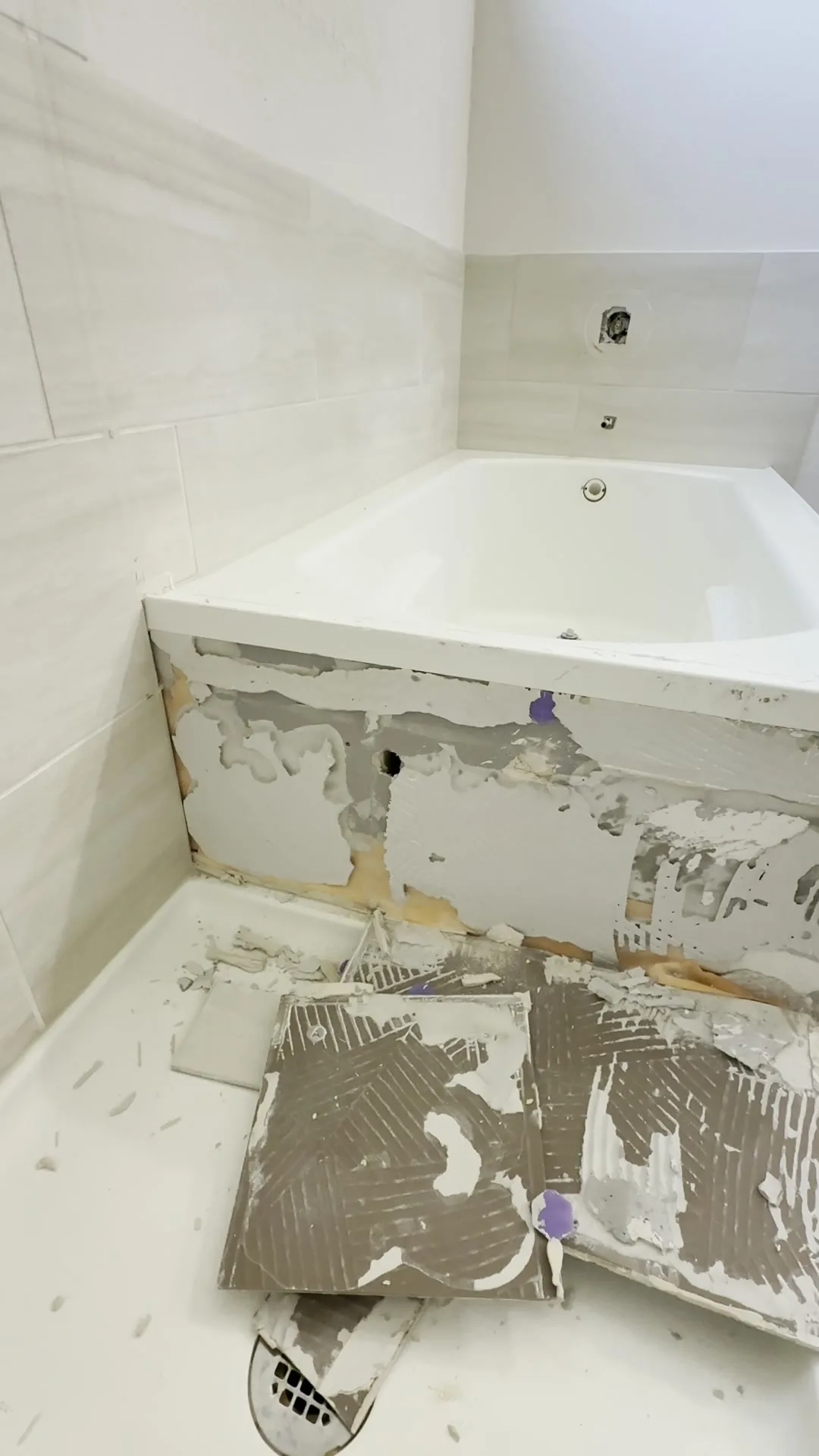
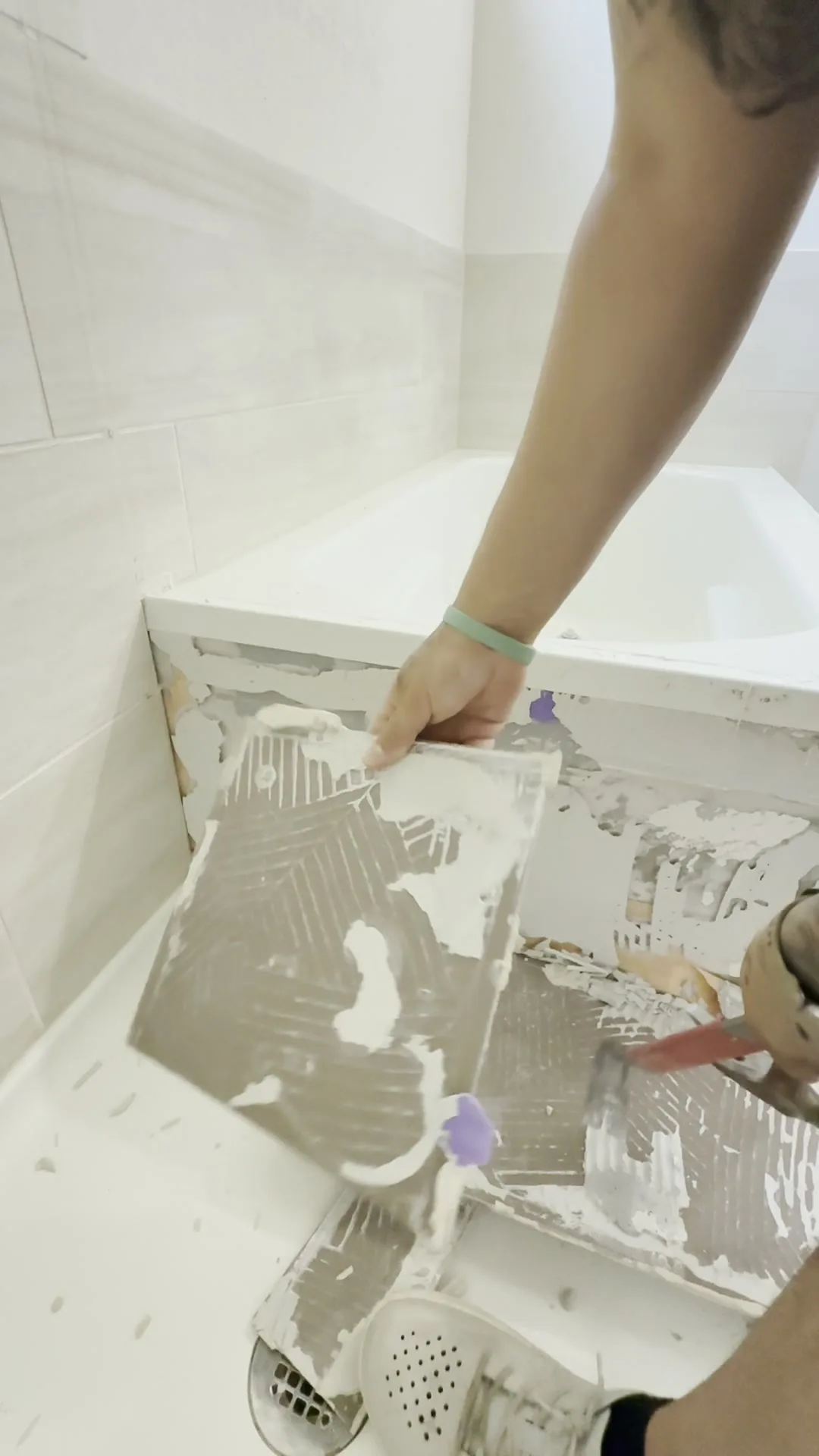
On the job shown here, the crew's own diagnosis, recorded on their walkthrough, was that these tiles had been set with mortar on the substrate only rather than back-buttered, and that this was why they were coming away so easily. The photographs show the removed tiles, though they cannot establish the cause of the easy removal by themselves.
On the back of the pieces there are stripes of hardened mortar where the trowel ridges made contact, and bare patches between them. The tile was coming off the lower face at the base of the tub a piece at a time, with a flat bar and not much force behind it.
So yes, the tile will be able to stick on there — but it was relatively easy for me to pop this thing on out.
And then there is what the tile was stuck to
Removing the tile also exposed the surface underneath: at the base of the tub, the tile had been set straight onto ordinary drywall.
Drywall is not a waterproofing material. What that means for any particular wall depends on where it sits and what else is behind it, which is exactly why it is worth being precise about what was documented here: the lower face at the base of the tub. These photographs do not show what was behind the tile higher up the wall.
Which is the part worth sitting with as a homeowner. From inside a finished bathroom there is very little to see. What a wall is made of behind the tile does not show up in a photograph, and it does not show up on a walkthrough of the finished room. It becomes visible when the tile comes off.
What has to stay where it is
Demolition does not only turn up problems. It also helps settle questions a drawing cannot answer by giving the crew a clearer view of what is inside the walls.
On a different job, a wall had to stay exactly where it was because of plumbing running inside it. So it stayed — and stopped being an obstacle and became part of the design instead, as the partition wall the new shower opening was formed around.
That is not a compromise in the bad sense. It is the layout being negotiated with the house that actually exists rather than the one on the drawing, and demolition is when that negotiation happens. If your plan changes slightly in the first week, this is often why.
Protecting the house before demolition
All of this happens inside a house somebody is still living in, which is why containment goes in before the first tile comes off. On this job the floor protection is already down and taped along the perimeter; covering the closet and the entrance to the rest of the house are described on the walkthrough as the next things to do.
It is not ceremony. A bathroom demolition generates a lot of dust in a short time, and the difference between a crew that seals the room first and one that does not is a difference you keep finding in the rest of your house for weeks.
What demolition hands off to
Once the room was stripped, the next day's plan on this job was already set: cut out the old concrete, centre the drain where the new shower needed it, cap and redo the plumbing around it, and start putting up GoBoard, a waterproof backer board. From that point a bathroom is being built rather than removed.
Which leaves one genuinely useful thing to ask for. If you are having a bathroom done, ask your contractor to walk you through the room while it is stripped, before the new board goes on. It usually takes a few minutes, and it is the point in the job where the answer to “what is actually behind there?” is simply visible.