Remodeling Process
A shed becomes a room the moment you treat it like one
Insulation, a mini-split, a gutter, flooring, paint inside and out. The list is longer than people expect — and the ground it sits on matters more than the building.
4 min read
People tend to picture a shed conversion as a decorating job. Clear it out, line the walls, put a desk in. The reason it costs what it costs is that a shed is a structure built to keep rain off a lawnmower, and a room is a structure built to be comfortable in for eight hours at a stretch. Almost everything between those two things is work you cannot see afterwards.
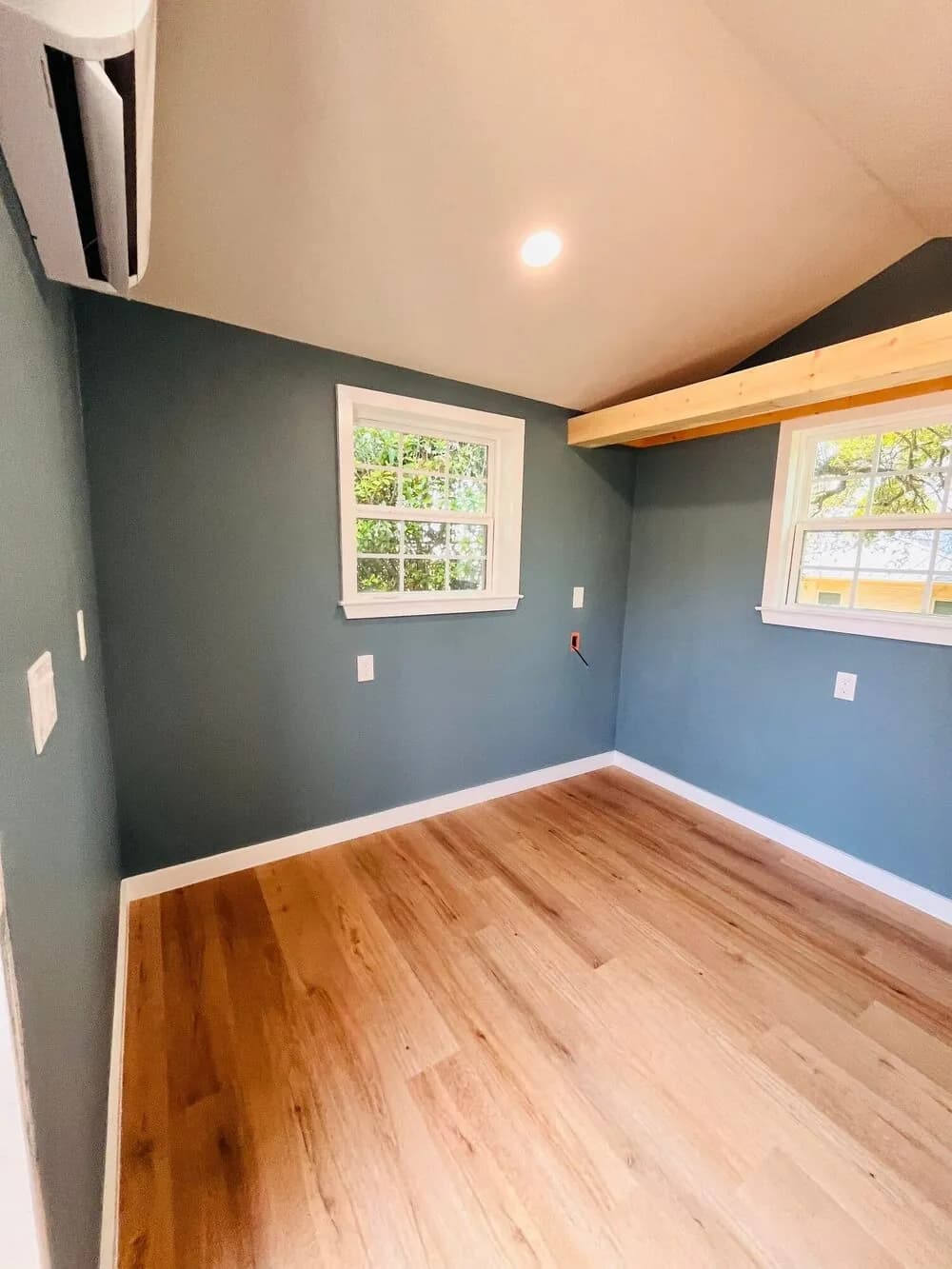
On one outbuilding conversion — the homeowner's brief was a home office, somewhere to work away from the house — the list ran to insulation, drywall, new windows, a mini-split, siding repair, interior and exterior paint, a gutter, plank flooring and baseboards.
Insulation and climate control are not upgrades
In this climate they are the difference between a room and a shed with furniture in it. An uninsulated outbuilding in a Texas summer gets uncomfortable fast, and finish work does not change that.
A mini-split is a common answer in a building with no ductwork to tie into: one wall-mounted head inside, a line set through the wall, a condensing unit outside. On that job a mini-split is what went in.
The details that make it read as a building
Two decisions on that job are worth stealing. The first was a late one: case out the windows. In the owner's words on the walkthrough, doing that is what makes the whole room come together. Trim around an opening reads as architecture; a bare drywall return reads as a shed that has been lined.
The second was a piece of angle iron the homeowner wanted left in place, so a shelf could be built on top of it. It is a solid piece of metal, and he did not want to be looking at it. So it was wrapped and finished to read as a beam — the metal kept, the appearance changed.
Outside, the same logic: a gutter and downspout added, and the siding repaired.
The part worth deciding before anything else
Here is the lesson that matters most, and it has nothing to do with the finishes.
On that job the building sat in the lowest part of the yard. After a hard rain the water came up into it — and it happened after the inside was finished. Painting, drywall, texture, floors, all done. The water line was still visible afterwards.
The work was put right. But the point for anyone thinking about converting an outbuilding is that the question of where water goes in a heavy rain is worth settling before the first sheet of insulation, not after the floor is down. A shed can sit in a low spot for years without anyone noticing, because a shed does not care. A finished room does.
Things that will take longer than you think
Doors. On that job the front entry door was the last thing to arrive and held up the finish by itself — a single ordered item that the rest of the schedule waits on.
It is worth asking early which parts of your build are ordered rather than bought, because those set the end date more reliably than the work does.
It is a more common project than it sounds
This is not a one-off. The same company has been called out to convert sheds into a pair of tiki sheds and into a dance studio, and the same pattern shows up: the finishes are the easy part, and the building envelope, the climate control and the ground underneath decide whether it works.
If you are looking at a shed in your backyard and wondering whether it could be a room, the honest answer is usually yes. The useful question is not whether it can be done, but what is already wrong with the building and the spot it stands on — because that is usually what drives the budget.
Planning other home improvements?
See what the process could look like for your home.
Book a Walkthrough